

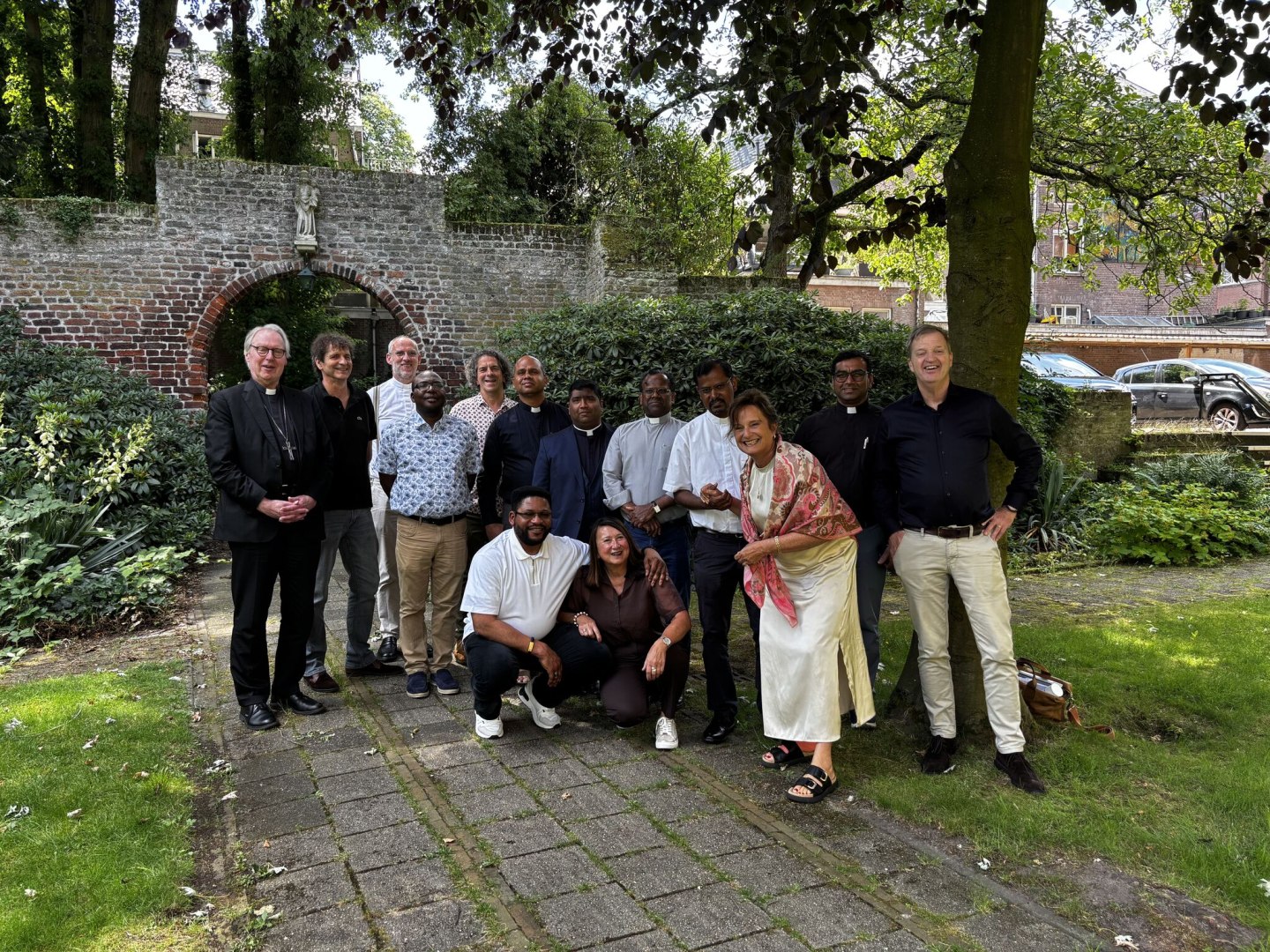
Special partnership with the Diocese of 's-Hertogenbosch
2 july 2026
STE Languages is particularly pleased with the special partnership with the Diocese of 's-Hertogenbosch. On Monday, 29 June, another meeting took place where the overseas priests demonstrated that they are making great progress in their Dutch language development!
STE Languages has a special partnership with the Diocese of 's-Hertogenbosch. Together, we are working on developing and improving the priests’ Dutch language skills. They come from various countries such as Uganda, Brazil, and India, and they are developing the Dutch language from the basic level with great enthusiasm and dedication. They receive their first lessons online in their country of origin. This is followed, provided they prove suitable, by the Basic Civic Integration Exam Abroad. In consultation with the Diocese, the priests will then start working in a parish. The ultimate target level that they will achieve once they are in the Netherlands is C1+ (near native), which is the second highest language level possible. It is important for them to learn to use the Dutch language empathetically, with the right words and intonations.
On Monday, 29 June, STE Languages, together with the staff of the Diocese including Bishop Gerard de Korte, Vicar General Theo Lamers, and Episcopal Delegate Peter de Vries, were present at the St. John's Centre in the centre of Den Bosch to witness their high level of Dutch language proficiency. It was a great pleasure to listen to their moving and remarkable presentations. The day concluded with a pleasant lunch.
For the Diocese of 's-Hertogenbosch, the solution to the shortage of priests is attracting priestly talent from abroad. In this diocese, one in five priests is now from abroad. This development is accelerating, also in other dioceses. Attracting clergy from abroad is part of a broader global movement called ‘reversed missionary’. In the past, many missionaries were sent out from the Netherlands, especially to Africa, Asia, and South America. Due to secularization, that is now reversed: clergy from those regions are coming to Western Europe.