

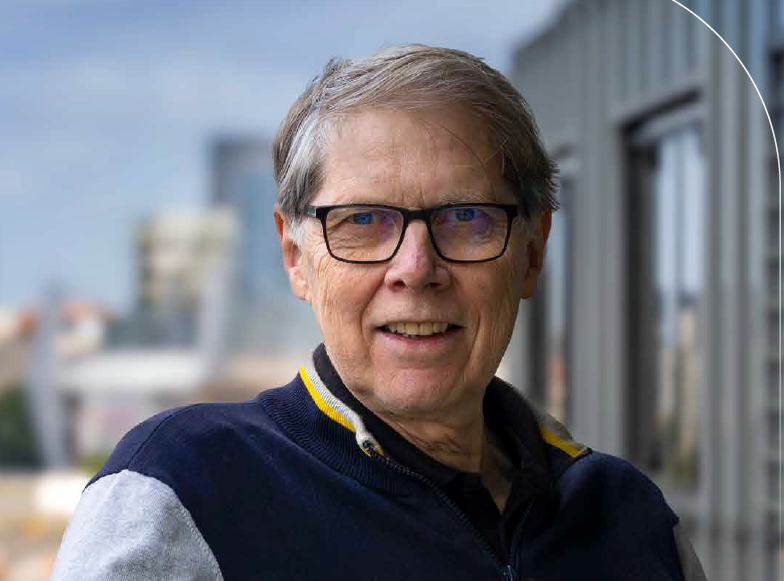
‘Language is part of a country’s identity’
9 january 2026
Wim Daniëls has been fascinated by language since childhood—especially dialects. In the increasingly international Brainport region, dialect is becoming harder to find, and even Standard Dutch seems to be under pressure. Wim explains why that’s both understandable and unfortunate.
“When I was a boy and said appelsien, I was ‘corrected’— apparently, it should be sinaasappel. But if you look at the origin of both words, they mean the same thing. A sinaasappel is literally a China apple, a fruit from China. In my dialect, appelsien is just a reversal of that.”
Wim describes it like this: “Every word in a language wears a kind of mask. When you take that mask off, you see what the word originally meant.” That idea fascinated him so much that he decided to study language. But he soon discovered that language is fascinating for many other reasons too: the history of standard language, dialects, how languages evolve, and what makes one written text more effective than another. “I’m especially intrigued by what makes one piece of writing stronger than another.”
About Wim Daniëls
Wim Daniëls is a writer, television and theatre creator. He has lived in Eindhoven for many years but grew up in the village of Aarle-Rixtel. Wim has written more than a hundred books, several of which became bestsellers. Many of his works explore the history of specific subjects, such as villages, bicycles, going on holiday, primary school, and language.His most recent book, titled 'De middelbare school', focuses on the history of secondary education. On television, Wim has been the presenter of the programme 'Nederland op Film' for the past five years. He also co-hosted the TV series 'Het dorp' alongside Huub Stapel.
More standard language
Anyone who studies the history of language inevitably encounters dialect. Before the standard language was formalized, everyone spoke in dialect. So why is that different today? “Dialects are under pressure due to increased mobility. People move house easily
and frequently. That trend has been going on for quite some time. In fact, back in 1959, a study from Tilburg University examined ‘immigrants’ in Brabant. But at the time, ‘immigrants’ didn’t mean people from other countries. It referred to Dutch citizens from outside North Brabant,” he says, smiling. “That tendency to move around means that grandparents and grandchildren often live far apart, and the dialect weakens over time. Dialects simply can’t survive when mobility becomes too high. It’s a shame, but it’s also a natural phenomenon. Mobility is part of modern society. I don’t live in my hometown anymore either.”
Brainport region
In the Brainport region, where people from all over the world come together for work or study, dialect has all but disappeared. That’s a pity, according to Wim. “Dialects are much richer in sound than the standard language. My own dialect, from Aarle-Rixtel, has around eighty distinct sounds. Standard Dutch has just over forty.”
And it’s not just dialects that are struggling in Brainport — even Standard Dutch is under pressure. “Many expats and international students mainly use English to communicate.” Wim finds that regrettable. “Few make a real effort to learn Dutch, which I find surprising. If you live and work in a country, you should have respect for its language, because language is part of a country’s identity. But many people don’t see it that way at all. They’re perfectly fine navigating everything in English. I see that as a loss.”
Lost for words
So is the Dutch language under threat? “To a certain extent, yes,” says Wim. “But Dutch has always borrowed words from other languages. In such a small language area, that’s practically unavoidable. If we suddenly decided to ban all foreign words, we’d often be left lost for words.”
According to Wim, our vocabulary clearly shows the influence of other languages. “That’s a result of historical power dynamics. Yes, today we’re flooded with English words, but many of those originally come from French.” The concern now goes beyond borrowed vocabulary to full English phrases replacing Dutch ones. “And that’s where it starts to become dangerous for Dutch.”
Brabant identity
The arrival of internationals influences not just the language, but also the local culture. Is there such a thing as a Brabant mentality? Wim hesitates. He gives lectures all over the country and doesn’t see huge differences in how friendly or open people are. Traits often quickly attributed to Brabanders.
He refers to a quote by Wim van de Donk, former King's Commissioner for North Brabant, when talking about the so-called Brabant mindset. “He once said that in Brabant, business is done with a combination of hard and soft. That might actually hold some truth.
This past May, I attended the Brainport Awards ceremony, where three major business prizes were handed out. What struck me was how much goodwill there was among the companies. Rather than emphasizing competition, they were seeking ways to become stronger together.”
The joy of language
Wim stresses that it’s better to enjoy language than to complain about it. “Language is wonderful to play with, and the masquerade of words I mentioned earlier is part of that magic. It can be deeply satisfying to express yourself in a way that really has an effect—when your words and sentences truly land.”
(Source: FRITS Media magazine Medelanders. Text: Mirthe van Wijngaarden. Photo: René Manders / DCI.)