

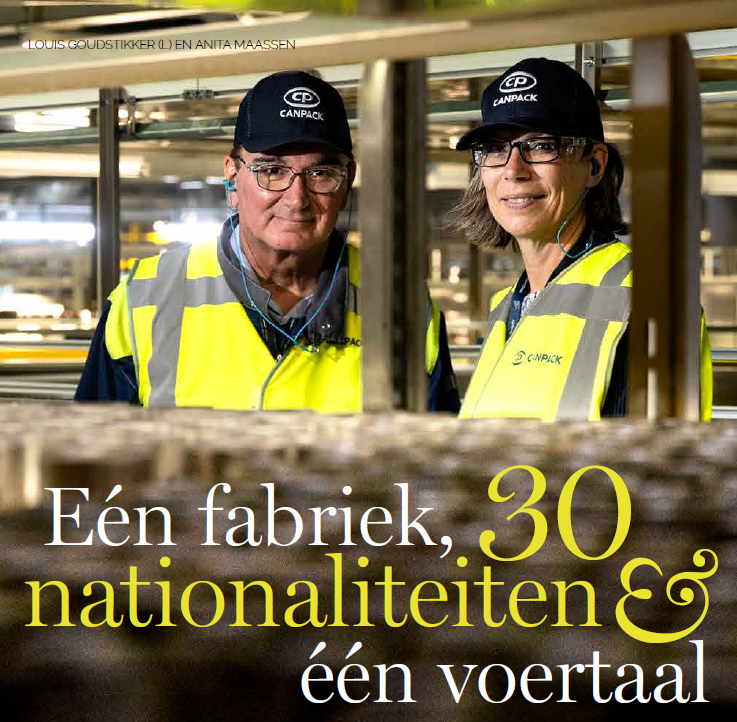
One factory, 30 nationalities & one shared language
9 february 2026
The Canpack Group is one of the most technologically advanced packaging manufacturers in Europe for the beer, soft drinks, and food industries. Annually, the Canpack factory in Helmond produces a massive volume of approximately four billion (4,000,000,000) aluminum cans for beer and soft drinks.
At Canpack’s factory in Helmond, you’ll hear dozens of languages every day. But on the shop floor, clear communication is essential. With 128 truckloads of cans leaving the site daily, teamwork is non-negotiable. That’s why Canpack chose one common language: English. Together with STE, they developed a language policy and lesson programme. HR Manager Anita Maassen says, “The training sessions are still ongoing, but we’re already seeing the results.”
On the outskirts of Helmond sits Canpack, part of the international Canpack Group, which operates 23 locations worldwide. The Helmond factory opened in 2017 and was quickly launched with the help of an experienced team from Poland. “Many of those Polish team members ended up staying, and over time, new staff from other countries joined us through staffing agencies,” explains Louis Goudstikker, Director at Canpack. “Today, we have thirty nationalities working here.”
As the workforce grew over the years - now exceeding 500 employees - a new challenge emerged: how to ensure everyone understands each other. Anita explains, “You can’t speak 30 different languages. For safety, collaboration, and a sense of unity, we made a decision: English would be our working language. Many of our procedures and training materials come from the United States, so the more natural English becomes here, the easier it is to work with that information without needing to translate everything first.”
Language policy
Canpack is one of the few companies in the region with a formal language policy. In 2022, together with STE, they defined the minimum required language level for each role. “For production roles, we set A2 as the baseline, so people can read and understand safety instructions,” Anita explains. “For team leaders, the bar is higher.” To implement that, more than 500 employees took part in an intake process.
Those who needed training were scheduled for classes. A major logistical feat, given the five-shift system. Louis: “Lessons always take place after a morning shift, but with rotating schedules, fixed training days weren’t an option. Together with STE, we created a planning system that outlines exactly who is available when. It was a real puzzle.”
The payoff
Once the logistics were sorted, not everyone was immediately enthusiastic about taking language classes. “If you’re on a team of fourteen Romanians, it might feel like you’re learning English just for that one colleague who doesn’t speak Romanian,” says Anita. “We’re now working on mixing the teams more deliberately.”Louis adds, “And let’s be honest—staying after an early shift for a training session isn’t easy. But fortunately, people are now seeing the effect. Employees who used to need a colleague to explain something are now able to speak up for themselves. That’s really rewarding to see.” And for those who are ready, there’s even the option to learn Dutch in addition to English. Anita: “Once someone’s English is at the right level, we cover the cost of Dutch lessons too. That’s also provided by STE. A small group has already started.”
The next step
What do Anita and Louis hope for the future? “That speaking English here becomes second nature, and not something people see as a chore. On the shop floor, but also during lunch or at the coffee machine.”
(source: FRITS Media magazine ‘Medelanders’, text: Djaydee Kraus | photo: René Manders/ DCI)